
Repair
- Leak Pattern
- One or two sources
- Core Samples
- Dry beside the leak
- Membrane
- Flexible and attached
- Deck
- Solid from below
- Typical Scope
- Seams, flashing, drains
Commercial Roofing in Louisville, KY
As a Louisville commercial roofing contractor, we repair, replace, and install TPO, EPDM, flat, and metal roofs on business and industrial buildings across Louisville Metro.
Repair or Replace
Every Louisville commercial roofing contractor should answer this first. Core samples and a seam probe settle repair or replacement.
What We Do
Nine services cover a commercial roof from the deck up, from a single split seam on a strip center to a full tear-off on a distribution building.
 Matched Repairs
Repair fits a Louisville roof when leaks trace to a split seam, a puncture, loose flashing, or a clogged drain and the insulation around it is still dry. The fix goes where the water enters.
 Tear-Off to Deck
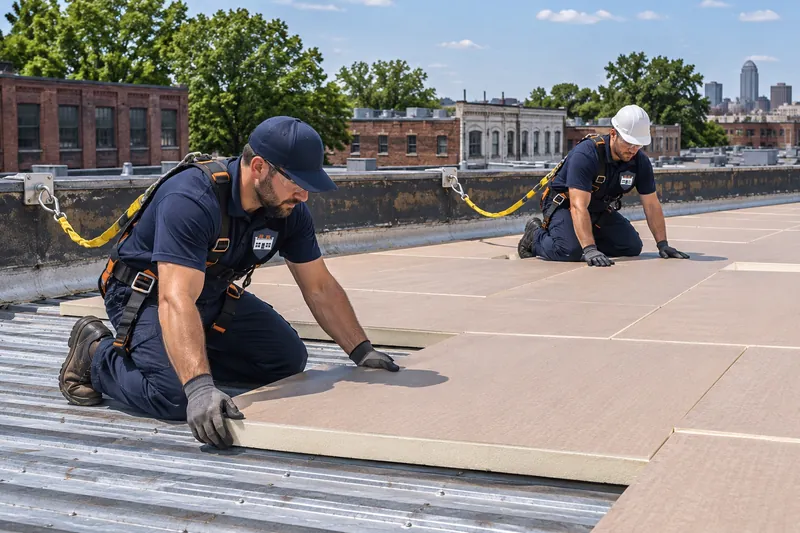
Replacement fits when cores find wet insulation across the roof, the membrane is brittle, or rust has reached the deck. The old roof comes off and the deck is repaired before new insulation goes down.
 Welded Seams
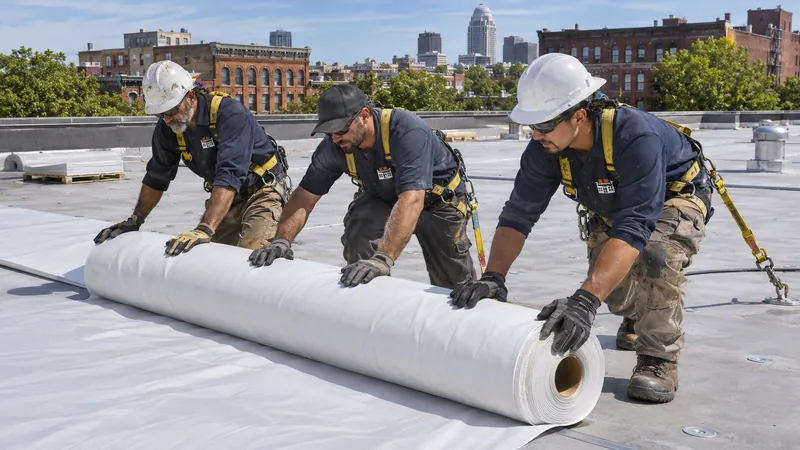
TPO fits large, open Louisville roofs with summer cooling loads. Wide white rolls cut the number of laps, and hot-air welding fuses each seam into one sheet before the probe test.
 Taped Seams
EPDM fits buildings with movement, cold-weather exposure, or an existing rubber roof to match. The black membrane comes in big sheets, and primed tape seams can be patched cleanly for years.
 Tapered Drainage
Flat roof work fits built-up, modified bitumen, and single-ply roofs where water ponds, drains clog, or plies blister. Drains get reset, and tapered boards or crickets send water where it belongs.
 Standing Seams
Metal roofing fits shops, steel buildings, and newer warehouses. We install new standing-seam or ribbed panels, replace rusted ones, renew fasteners, and reseal laps and trim where water gets in.
 Reinforced Membrane
Industrial roofing fits plant roofs with exhaust fans, process piping, catwalks, and daily maintenance traffic. Curbs, pipe supports, and walk paths get detailed for vibration, heat, and the work below.
 Core Samples
Inspection fits any roof due for its spring or fall check, a roof hit by hail, or a building about to be bought or leased. Cores and photos show what the surface hides.
 Seasonal Visits
Maintenance fits roofs under trees, roofs with many rooftop units, and newer roofs owners want to last. Spring and fall visits clear drains, reseal curbs, and close small seam openings early.
How a Job Runs
Every job, from one leaking curb to a full tear-off, follows the same four steps, and each step is planned around your building's hours.
We walk the whole roof, check every seam, curb, drain, and edge, and pull core samples where wet insulation is suspected.
You receive roof photos, the repair or replacement options, and a price for each, with the permit question answered for your address.
Crane lifts, roof tear-off sections, and noisy work are set around your hours, deliveries, and loading dock traffic.
After the last seam is closed, we walk the roof with you, haul off debris, and point out what to watch between inspections.
Call and tell us where the water shows up inside and what sits on the roof above it. That sends the first visit straight to the right drain, curb, or seam.
Roof Problems We Fix
Most Louisville commercial roof leaks start at the details: seams, flashing, drains, and penetrations. These six conditions come up on area roofs again and again.
Heat, cold, and building movement work on TPO and EPDM seams until one opens. We probe every seam and reweld or re-tape the failures. Short open lengths rarely show from the ground, so a hand probe along each lap is the only sure check.
Usually Means: Seam welds or tape have aged out
Mortar joints and counterflashing in brick parapet walls wear out on older Louisville buildings, letting water behind the base flashing and into the wall.
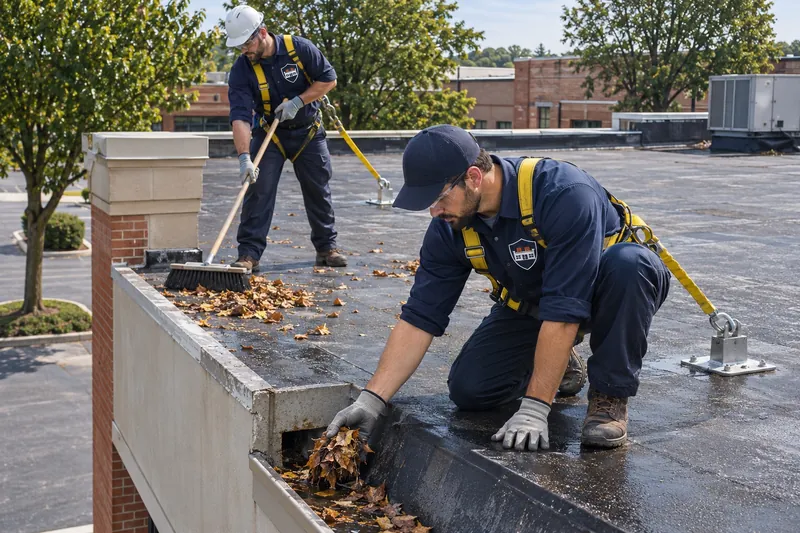
Leaves and debris block drains and scuppers, and water that sits for days finds any weak seam.
Rooftop units, pipe boots, and pitch pans move and shrink at their seals.
Water that gets in spreads through the insulation long before stains appear inside.
Why It Pays
A Louisville commercial roof that gets repaired at the source and checked twice a year costs less to own over time than one handled leak by leak.
Wet insulation loses its insulating value and adds weight to the deck. Catching leaks early keeps the boards dry and the steel deck free of rust.
Probing seams on every visit catches short openings in TPO and EPDM before water travels under the membrane.
Repairs aimed at the actual entry point, instead of the stain below, keep water away from inventory, ceilings, and equipment.
Most repairs happen from the roof surface, so offices, stores, and plants below keep working while drains and seams get fixed.
Regular maintenance and timely repairs help a membrane reach the end of its normal service life instead of failing early.
A written repair list ranked by urgency lets you budget for the roof over several years instead of paying for emergencies.
Where We Work
We provide commercial roofing in every area listed below. Outside these areas? Please call us or send us a message.
| Area | County | Common Roofs |
|---|---|---|
| Louisville Home Base | Jefferson | TPO, EPDM, built-up, and metal roofs on every building type |
| Butchertown | Jefferson | Brick industrial and warehouse buildings with parapets |
| Portland | Jefferson | Older brick commercial blocks and riverfront warehouses |
| California | Jefferson | Rail-side industrial and older commercial buildings |
| Park Hill | Jefferson | Industrial buildings along the rail corridor |
| Old Louisville | Jefferson | Institutional buildings, churches, and older masonry |
| Germantown | Jefferson | Former mill buildings and brick storefronts |
| The Highlands | Jefferson | Storefront rows, restaurants, and offices |
| Clifton | Jefferson | Storefronts and small commercial buildings |
| Crescent Hill | Jefferson | Storefronts, churches, and institutional buildings |
| Audubon Park | Jefferson | Small commercial buildings near the airport edge |
| Camp Taylor | Jefferson | Low commercial, shop, and warehouse buildings |
| Wilder Park | Jefferson | Warehouses and distribution buildings |
| Area | County | Common Roofs |
|---|---|---|
| Bon Air | Jefferson | Offices, medical buildings, and retail |
| Newburg | Jefferson | Light industrial, shops, and churches |
| Hikes Point | Jefferson | Shopping centers and offices |
| Okolona | Jefferson | Retail strips and light industrial on Preston Highway |
| Valley Station | Jefferson | Retail centers, churches, and shops on Dixie Highway |
| St. Matthews | Jefferson | Retail centers, offices, and medical buildings |
| Lyndon | Jefferson | Offices, medical buildings, and retail |
| Shively | Jefferson | Plants, warehouses, and Dixie Highway retail |
| Watterson Park | Jefferson | Airport-area warehouses and distribution buildings |
| Prospect | Jefferson, Oldham | Offices, retail centers, and churches |
| Hillview | Bullitt | Retail, shops, and light industrial |
| Shepherdsville | Bullitt | Distribution and logistics buildings along I‑65 |
Also Serving
Every listed area gets the same roof walk, written scope, and free estimate.
Short answers to the questions Louisville building owners ask first. Call for anything about your own roof.
Roof Condition
A Louisville commercial roofing contractor handles the roof of a business, plant, or institution from the steel or wood deck up: insulation, membrane or metal panels, flashing, edge metal, and drains. The work covers repairs, full replacements, new systems, inspections, and scheduled maintenance.
Most Louisville commercial roofs are low-slope: TPO and EPDM single-ply membranes, plus older built-up and modified bitumen roofs on mid-century buildings. Metal panels show up on newer warehouses and shop buildings, while the older brick districts near downtown add parapet walls and internal drains.
Membranes and Systems
We do. On a Louisville warehouse, the leak is traced on the roof first, usually to a seam, a drain, a curb, or a dock-side edge, and then closed with materials that match the existing membrane. Wet insulation around the leak is cut out and replaced.
Yes. The free estimate covers a roof walk, the problems we find, and a price for each repair or replacement option. It costs nothing and you are under no obligation to hire us afterward.
Planning the Work
The price depends on the roof size, the system, how many old layers come off, deck repairs, insulation, and the equipment on the roof. Access and crane needs matter too. We price the work in writing after a free roof walk, so the number fits your building.
Twice a year works for most Louisville commercial roofs: spring to catch freeze-thaw damage and fall before leaves fill the drains. Add a check after hail or high wind, and after HVAC crews have worked on rooftop units.
Next Step
Send the property address and what you are seeing, or call. We set up a roof walk, then send photos and a written price for each option.
Roof Leaking or Wearing Out? Have Us Call You
Leave a name and number to talk about your roof.
Thank You. Your Request Is In.
We have your name and number and will call you about the roof. To talk now, call (502) 293-5786.
Or call (502) 293-5786